Chapter 6 · concept 3 of 3 · show all
2Tokens, cost and your first RAG
4Chunking
- 4.1Why we chunk, and the main chunking strategies
- 4.2Structure aware chunking and tables
- 4.3Chunk size, overlap and token based sizing
- 4.4Contextual chunking and late chunking
- 4.5Parent child and multi representation indexing
- 4.6Chunk metadata, provenance and the chunking debugging playbook
- Chapter overview
7Finding the right chunks
8When retrieval fails
Late interaction and multivector retrieval
Instead of one vector per chunk, keep many (per sentence, or per token as in ColBERT) and score by the best match. We tested the sentence version; it used 12 times the vectors for the same result.
A real question
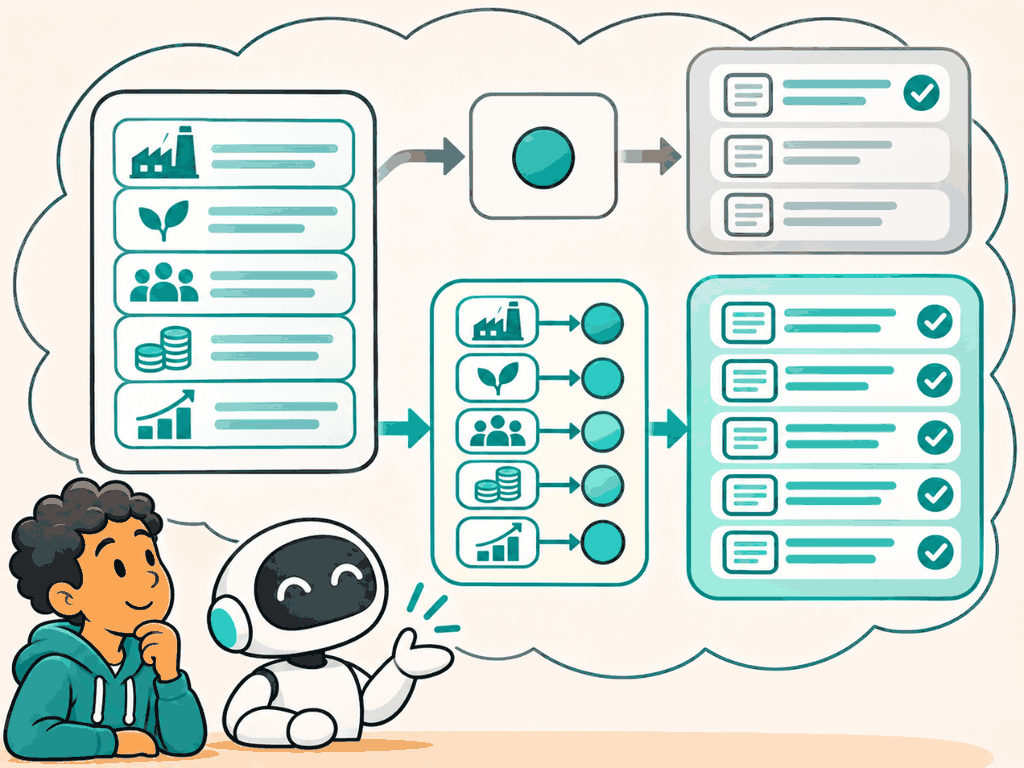
A chunk talks about five things. Can one vector stand for all five?
One vector is an average, and the one sentence you need gets diluted. Multivector retrieval keeps a vector per sentence, or per token, and scores a chunk by its best match.
The problem
Why this matters

More vectors per chunk always find more answers.
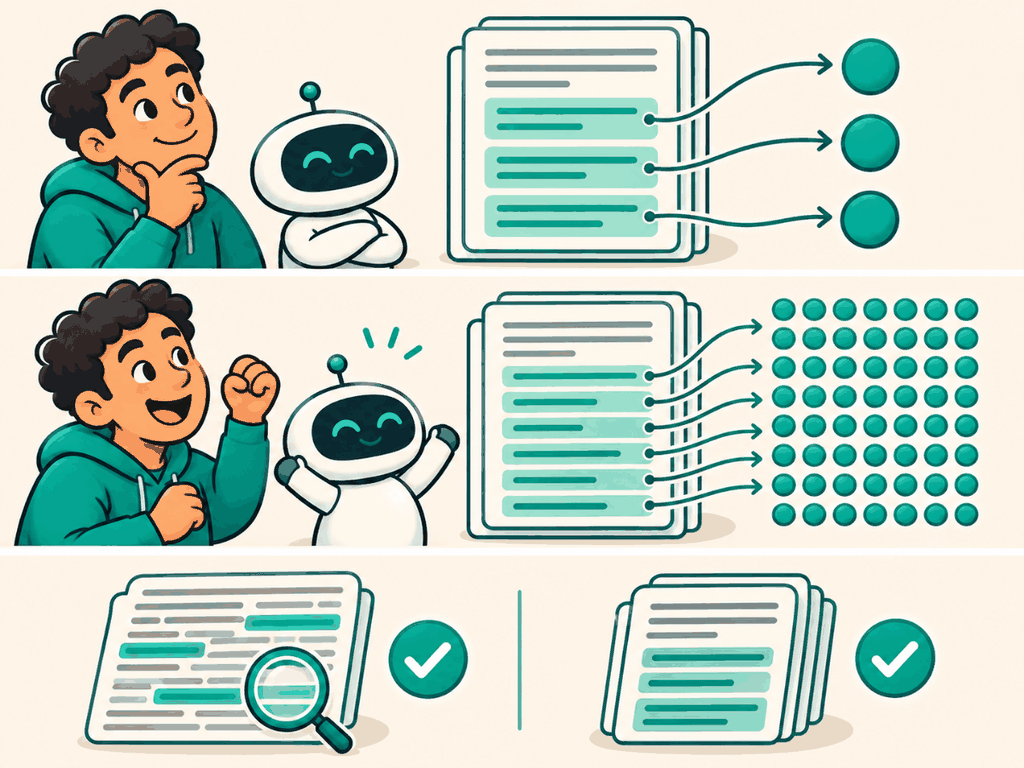
We stored one vector per sentence: 405 vectors instead of 33. Recall stayed at 44 of 47. It helps when chunks are long and mixed; ours are short and on one topic.
Why not the simpler way
A 512-token chunk of a policy might cover scope, exceptions, deadlines and contacts. Its single vector is a blend of all four. A question about the deadline has to compete with that blend. Smaller chunks are one fix (RAG-15); keeping several vectors per chunk is another.
The idea
The idea in plain words
Single-vector (bi-encoder) retrieval: one vector per chunk, one per query, one dot product. Multivector retrieval: many vectors per chunk, scored by how well the best pieces match. Late interaction is the token-level version: query and document are encoded separately (so documents can be indexed ahead of time), and they "interact" only at search time, token by token.
A book's back cover summarizes the whole book. Its index lets you find the one page that mentions your word.
How it works
Step by step
 1
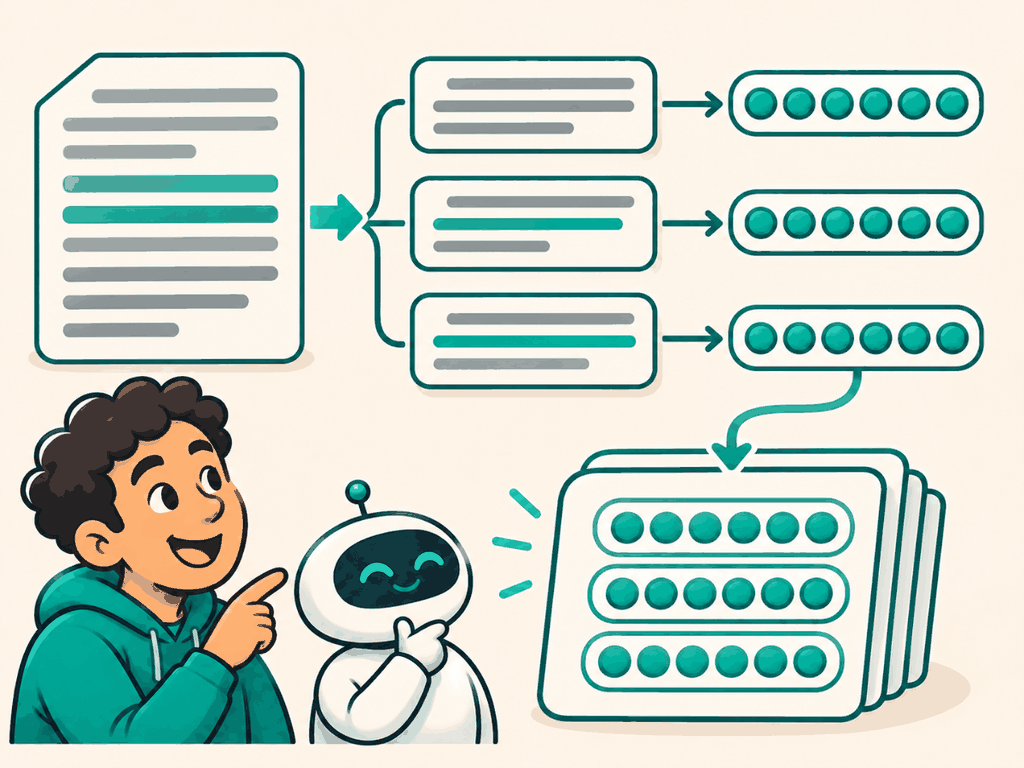
Split into pieces
Embed each sentence, or in ColBERT each token, separately. A chunk now has many vectors.
 2
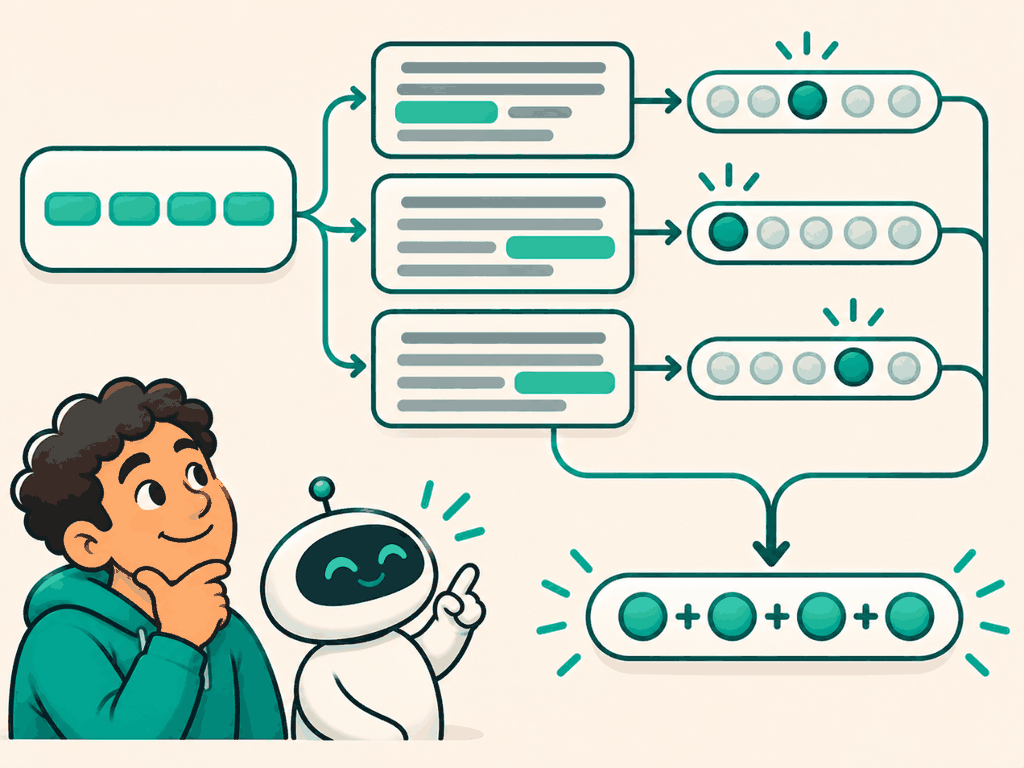
Score by best match
Compare the question with every piece and keep the best (MaxSim). ColBERT sums the best match for each query token.
- 3
Pay for it
Storage and compute grow with the number of pieces. Systems compress the vectors and search in two passes.
In detail
Sentence MaxSim (what we tested): split each chunk into sentences, embed each, and give the chunk the highest sentence score. Simple, and it works with any embedding model.
ColBERT (Khattab and Zaharia, arXiv 2004.12832): a model trained to output a vector per token. The score is the sum, over query tokens, of each token's best match in the document. ColBERTv2 and PLAID compress the token vectors and use a first pass over centroids to keep it fast.
Multi-representation is a cousin: index a summary, a few hypothetical questions or the title as extra vectors pointing to the same chunk (RAG-17).
The code
Try it in Python
import re

def sentences(chunk: str) -> list[str]:
    return [s for s in re.split(r"(?<=[.!?])\s+|\n+", chunk) if len(s.strip()) > 20]

pieces = [(i, s) for i, c in enumerate(chunks) for s in sentences(c)]
piece_vecs = model.encode([s for _, s in pieces], normalize_embeddings=True)

def maxsim_search(q_vec, k=3):
    best = {}
    for (i, _), v in zip(pieces, piece_vecs):
        best[i] = max(best.get(i, -1.0), float(v @ q_vec))
    return sorted(best, key=best.get, reverse=True)[:k]
See it
What we measured
Measured · evidence recall@3
Polder corpus, 34 recursive 512 token chunks, bge-small. Sentence split on . ! ? and line breaks, sentences under 20 characters dropped. Chunk score = best sentence cosine.
Measured 2026-11-04 with corpus/scripts/measure-parts-4-7.mts. ColBERT itself was not measured.
Try it on a real example
Same 34 chunks, 47 questions, bge-small
The baseline.
Choosing
Use it when, avoid it when
- Long, mixed-topic chunks you cannot make smaller
- Cases where a reranker is too slow and recall is still low
- Short, single-topic chunks: no dilution to fix
- Adding it before a reranker, which is easier to try
What it costs · Storage and embedding work grow with the number of pieces: 12 times here for sentences, more for tokens.
In production
Token-level indexes are several times larger than single-vector ones, and need a store that supports them. Try multivector when chunks are long, cover several topics, or when single-vector search ranks the right document low and smaller chunks are not an option. Measure against a reranker first (RAG-31): a reranker also reads token by token, only over the top candidates, and needs no new index.
Watch out
Common mistakes
- Late interaction means late chunking. Late chunking (RAG-16) pools token vectors into one vector per chunk; late interaction keeps them separate.
- Multivector is always better. It matched single-vector exactly on our corpus.
- It needs a new embedding model. The sentence version works with the model you already have; ColBERT needs its own.
Check yourself
Remember this
Remember these
- One vector per chunk averages everything the chunk says.
- Multivector keeps many vectors and scores by the best match.
- ColBERT does this per token, with compression to keep it affordable.
- On our short chunks, 12 times the vectors gave the same 44 of 47.
Say it in an interview
- 01A single vector averages a chunk; multivector keeps many and scores by the best match.
- 02ColBERT does it per token with MaxSim and compresses the vectors to stay affordable.
- 03On my corpus, one vector per sentence used 405 vectors instead of 33 for the same 44 of 47.
- 04It pays off for long mixed chunks; I would try a reranker first.
- 05Late interaction keeps token vectors; late chunking pools them.
Quick quiz