Chapter 6 · concept 1 of 3 · show all
2Tokens, cost and your first RAG
4Chunking
- 4.1Why we chunk, and the main chunking strategies
- 4.2Structure aware chunking and tables
- 4.3Chunk size, overlap and token based sizing
- 4.4Contextual chunking and late chunking
- 4.5Parent child and multi representation indexing
- 4.6Chunk metadata, provenance and the chunking debugging playbook
- Chapter overview
7Finding the right chunks
8When retrieval fails
Vector databases, ANN indexes and choosing a store
When exact search is enough, what approximate indexes like HNSW trade away, and how compression shrinks vectors 32 times, with measured recall on our corpus.
A real question
Do I need a vector database before I can build RAG?
Not at first. For thousands of chunks, comparing the question with every vector is fast and exact. Approximate indexes and databases matter when you reach millions of vectors, many users or frequent updates.

The problem
Why this matters

RAG starts with choosing and paying for a vector database.

Our labs keep 34 chunk vectors in a JSON file. An exact search over all of them took about 16 microseconds. Storage choice is a scaling decision, not a starting one.
Why not the simpler way
Tutorials often start by installing a vector database. That adds a service to run, a cost, and settings you do not yet understand, before you know whether retrieval even works. The real questions are how many vectors you have, how fast answers must be, how often data changes, and what else you need to filter on.
The idea
The idea in plain words
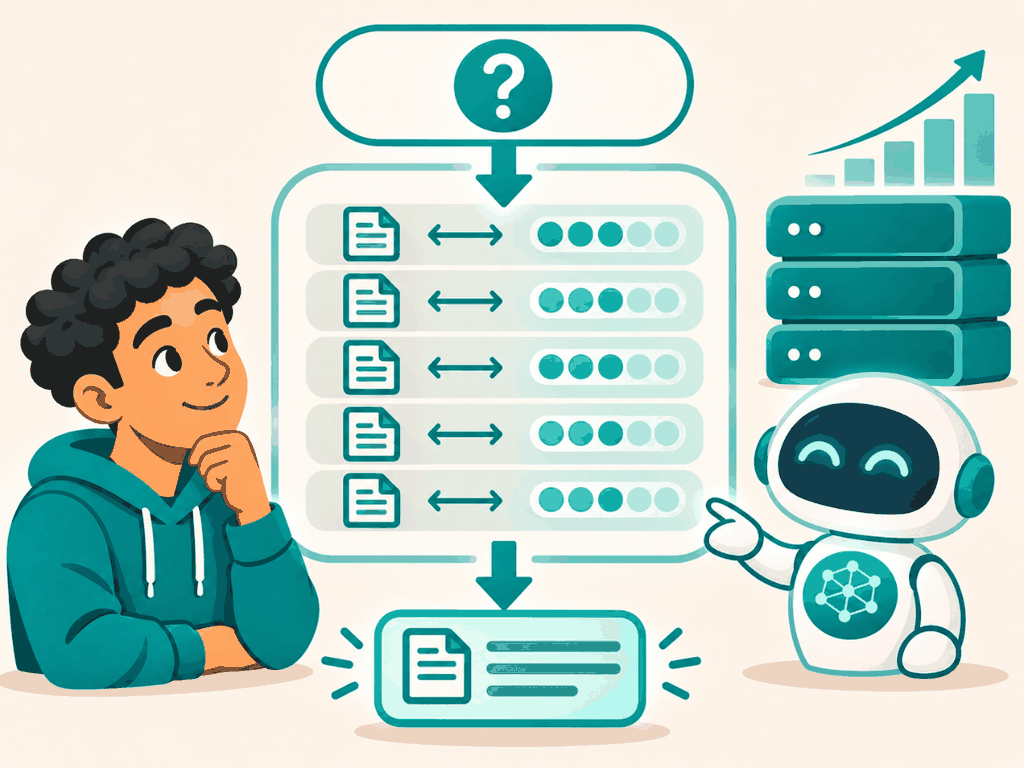
A vector store keeps vectors and finds the nearest ones to a query. Exact search compares with all of them. Approximate nearest neighbour (ANN) indexes organise the vectors so a search only visits a few. Compression stores each vector in fewer bytes.
Finding a friend's house: you could knock on every door in the city (exact), or ask for the neighbourhood, then the street, then the number (approximate, and almost always right).
How it works
Step by step
 1
Exact search
Compare the question with every vector. Always correct. Cost grows with the number of vectors.
 2
Approximate search (ANN)
An index such as HNSW links each vector to its neighbours and walks that graph. It checks a small share of vectors and sometimes misses the true best.
 3
Compress, then rescore
Store small codes (int8 or 1 bit per number) to save memory, then recheck the top candidates with full vectors.
In detail
HNSW (Malkov and Yashunin, arXiv 1603.09320) builds layers of a graph where each vector links to near neighbours. A search starts at the top layer and greedily moves closer. Settings like M (links per node) and ef (how many candidates to keep while searching) trade memory and time for recall.
IVF splits vectors into clusters and searches only the clusters nearest the query. Fewer clusters searched means faster and less exact.
Quantization. int8 rounds each number to 256 levels; binary keeps only its sign and compares with Hamming distance. Rescoring the top candidates with the original vectors recovers most of the loss.
What a store must also do. Metadata filters (version, language, access role), deletes and updates without a full rebuild (RAG-12), backups, and hybrid search with keywords (RAG-28).
The code
Try it in Python
import numpy as np

def to_binary(v: np.ndarray) -> np.ndarray:
    return np.packbits(v > 0, axis=-1)            # 384 floats -> 48 bytes

def search_binary_rescore(q, docs_f32, docs_bin, k=3, candidates=10):
    qb = to_binary(q)
    ham = np.unpackbits(docs_bin ^ qb, axis=-1).sum(axis=1)   # lower = closer
    cand = np.argsort(ham)[:candidates]
    exact = docs_f32[cand] @ q                                 # rescore with full vectors
    return cand[np.argsort(-exact)[:k]]
See it
What we measured
Measured · evidence recall@3 by storage format
Polder corpus, recursive 512 token chunks (34), bge-small vectors, 384 dims. int8: per-dimension scale; binary: sign bits with Hamming distance; rescore: binary top 10 reordered with float vectors. Timing: plain TypeScript on a laptop, 200 runs.
Measured 2026-11-04 with corpus/scripts/measure-parts-4-7.mts. ANN indexes were not measured: with 34 vectors there is nothing for them to speed up.
Try it on a real example
Same 34 chunks, same 47 questions, vectors stored four ways
The baseline: full precision.
Choosing
Use it when, avoid it when
- Exact search for small corpora and for testing ANN recall
- int8 or binary plus rescoring when memory is the limit
- A dedicated vector database before measuring a need
- Changing ANN settings without re-running the golden set
What it costs · Exact search: compute grows with corpus size. ANN: extra memory for the graph and tuning time. Compression: almost free, with rescoring.
In production
Start with what you already run: a Postgres extension, a search engine with vector support, or an in-memory array. Move to a dedicated store when measured latency or memory says so. Always test recall of the ANN index against exact search on your golden set after changing index settings: a fast index that misses answers is a quality bug, and nobody gets an error message. Filtering inside an ANN index can also drop recall when the filter is very selective; test that case.
Watch out
Common mistakes
- ANN is always accurate. It is approximate by design; measure recall against exact search.
- Compression ruins quality. int8 lost nothing here, and binary with rescoring lost nothing.
- A vector database is the RAG system. It is one component; chunking and evaluation matter more.
Check yourself
Remember this
Remember these
- Exact search is fine for thousands to tens of thousands of vectors.
- ANN indexes like HNSW trade a little recall for speed at large scale.
- int8 kept every answer here at a quarter of the memory.
- Binary plus rescoring kept every answer at 1/32 of the memory.
Say it in an interview
- 01At small scale I use exact search; it is correct and fast, 16 microseconds over 34 vectors.
- 02HNSW trades a little recall for speed; I test it against exact search on the golden set.
- 03int8 kept all 44 answers at a quarter of the memory.
- 04Binary vectors lost 4 answers, and rescoring the top 10 with floats brought them back.
- 05I choose a store for filters, updates and operations, not only for search speed.
Quick quiz